
Sunday, November 3, 2013

Khambalah: Victim of Reputation
Unfortunately, this video has no subtitles.. however, it's simple and easy to follow.. it's about two Saudis who happen to be in a bar in London but both of them don't want the other to know that he is a Saudi so they both start pretending that they are British and then it gets complicated when they events intensives.. I'll leave it up to the viewers to figure out what the video point is.
Calligraphy and Islamic Culture
Calligraphy and Islamic Culture By Lynette Haberman
 |
| Pre-9th Century Hijazi Script |
“Bism Allah al Rahman al Rahim,” the literal translation
being: “In the name of God, the merciful, the compassionate.”[1] This statement commonly
appears at the beginning of important written documents within Muslim
societies, and is an example of the importance of the written word within the
Islamic culture, as it represents the dedication of the projects achievement to
Allah. I found this to be a fitting
introduction as this subject is about the art of Islamic calligraphy.[2]
 |
| Mosque |
The art
of writing, to many scholars, is viewed as synonymous with the development and
expansion of religion. Islamic calligraphy also known as Arabic calligraphy is
a testament to that common belief. Scripts,
of eloquently flowing letters scrolled from right to left (as Arabic is a
Semitic language) in angular intricate designs form verses of the holy Qur’an,
songs, and poetry, pottery, and even woven into blankets, all equal in visual
and audial beauty.
As the
Muslim empire grew the practice of writing remained intact, the ancient
calligraphers’ devotion to delicacy and detail ensured its emergence as an art
form. The sacred symbolism of the art of
beautiful handwriting thus provides evidence of the religious and aesthetic
importance of Islamic calligraphy within Muslim culture.
A.
Schimmel writes in her book entitled Islamic
calligraphy: Iconography of Religions that “calligraphy is an art that expresses
the true Islamic spirit, even the Qur’an talks of the importance of writing.”[3] It was believed that the ancient calligraphers
were the primary reason for the preservation of the Qur’an, and because they were
maintaining the purity of the text they were preforming a sacred and holy
duty. It was an expression of their
devotion to Allah. And the amount of effort and time put into the copying of
the text in such an esthetically pleasing way became an integral part of
Islamic culture.
|
|
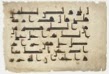 |
| Late 9th Century Kufic Script |
|

 | |
| Poetry |
Islamic calligraphy is written using
a pen made of reed known as a “qalam” it has an angled point which enables the
thick upward and downward strokes and the diamond shaped “dots” that are used
along the alphabet. Many of the artists use this method when creating their
poetry, or songs, or proverbs that are commonly viewed as Islamic art. However, the calligraphy scripts were also ideal
for being transcribed onto ceramics like pottery, and even stone work. These scripts were also used to decorate Mosques
all around their empire. Calligraphy was
implemented into almost every aspect of society throughout the early Islamic
world.[6]
Because
of the connection between religion and handwriting, calligraphy emerged within
Islamic society as an art form that is continually practiced. Many modern day Muslim artists look to the
holy books pages for inspiration, and as time passes the art of calligraphy continues
to change and represents something truly sacred within Islamic culture.
Understanding Islam, the Faith
Understanding Islam, the Faith by Andrew Ensslin

Perhaps the most basic aspect of Islamic culture,
language, and history is the religion of Islam itself. Islam as a faith influences not only these
but every other aspect of life for those who practice it. I have found that I knew surprisingly little
about Islam, especially as someone who takes joy in knowing the details of the
many great beliefs and actions that have played such a tremendous part in world
history. But beyond knowing how Islam as
influenced the course of history, what I have found most extraordinary is
understanding the basic tenants of Islam and just how closely it intertwines
with Christianity and Judaism. I had
generally believed that Islam was a very distinct religion that often found
itself at direct opposition to many other religions, but I am intrigued to
learn that not only is that not the case, but Islam derives its very basic
tenants on a foundation established by the earlier religions and the leaders of
those faiths. According to the website
What Is Islam About, “Muslims believe that the first
Prophet was Adam followed by a long chain of Prophets to guide
humanity. The
Qur’an, according to Muslim belief, is the word of God revealed to Prophet
Muhammad. It
mentions many other Prophets like Noah, Abraham, Isaac, Ishmael, Moses, Jacob,
Joseph and Jesus. All the Prophets brought the same message, i.e., belief in
one God, upright human conduct and belief in the accountability of human acts
at the end of time.”
This simple and fundamental concept has completely
changed what I thought I knew about Islam.
To be honest, most of what I know about the Islamic faith comes what is
portrayed on the American news and Hollywood films. Obviously it’s not the best representation of
a faith that is predominantly of another culture entirely than what Americans
are used to. However it is the
representation that unfortunately leads many Americans into complete ignorance
about what Islam really is, and why it is the fastest growing religion in the
world. Learning that the primary
teachers and figures in the other major religions such as Moses and Jesus are
incorporated into Islam as well is a concept that caught me by surprise. The connection is that Islam is believed by
those who practice it to be the final revelation of God through the prophet
Muhammad. God is believed to have spoken
prior to Muhammad through the prophets Adam, Noah, Abraham, and many more. With so many of the same figures involved in
Islam, I personally find it interesting that there is perceived to be such a
strong ideological divide between those who practice Islam and those who
practice Christianity, at least Christianity in the United States.
What seems to gain much of the attention in the
United States however is the perceived radical element of Islam that doesn’t
follow the basic mainstream belief of not allowing harm to fellow people. The violence committed by Islamic fringe
groups in the Middle-East and other places around the world form much of the
views by western culture that Islam is a religion of intolerance instead of a
religion of peace. The inner-religious
conflicts between the Islamic sects of the Shi’a and Sunni perpetuate the perception
of a turbulent faith. The trouble for
most Americans and I admit for me is being able to see through the negative
perceptions of Islam put out by the western media and understand what the faith
is about according to the overwhelming majority of those who practice it. That is why this class and the presentations
I have seen have been particularly interesting to me; I account for new
information and I find that old views of Islam or no views at all, are being
replaced by more factually accurate information. I really enjoy this class because it is a
subject about which I have known so little but as a result I learn a lot of
information every session.
Bibliography
What Is Islam About?
“What is Islam?” http://www.whatisislamabout.com/islam/what-is-islam/
(accessed
October 26, 2013)
Arabic Poetry
Arabic Poetry by Adam Crenshaw

Something that has fascinated me in
Arabic culture is poetry. Poetry in
Arabic society is a very important thing. I want to talk about what poetry was used for
in both pre-Islamic and Islamic Arabic culture.
In pre-Islamic Arabic culture,
poetry was an important way of communicating each tribe’s history. Within the tribe there would always be a poet
or Sha’ir. The Sha’ir was an important man, not only
because they would share their poetry but they would also chronicle the tribe’s
history. The Sha’ir was a kind of scribe
who would record a tribe’s history through poetry. At this time Arabic culture was a Bedouin
culture and travelled from a source of water to another source of water,
because of this they were very much an oral society. Meaning that they did not write all their
stories down they memorized them then recited them. So it was necessary for the chronicler, or
Sha’ir, to remember their stories in a fashion that would be easy to remember,
like poetry. They did manage to write
some of their poetry down but not a lot survived. Something that has survived time is the
Mu’allaqat. Mu’allaqat means “the hung
poems” and the Mufaddaliyat which means “Al-Mufadda’s examination or anthology”. It is a collection of eight poems that were
hung on the wall of the Kaaba. These
poems are still kept in high regard because they are a great source of history;
again, they are the recited histories of the people of that region.
After Islam began to spread through
the known world, poetry took on some different forms. Poetry was given a major role in the
political and religious realm of Islam.
The poet would recite and write poetry for the Caliph and his
court. Most of the poetry of this time
really focused on worldly pleasures but in these still ran the theme of
chronicling their history, and now in that mix was their new focus on their
religion. Now the Sufi Tradition of
Islam took a more mystical view of poetry.
They really tied the use of poetry to their worship and their
religion. In their poetry they would
speak of transcendence and other things that were considered heresy.
Something that these poets would
pride themselves in was the complexity of their poems. They would use all kinds of metaphors, puns
and other things to further complicate their poetry. There were several genres of poetry that
these poets would write under. Romantic
Poetry was exactly what it sounds like, they were romantic poems. They spoke of love stories and what courtly
love was. There was also Satirical
Poetry. Satirical poetry actually
focused on things such as, anthropology, sociology, and psychology. Not in the sense of writing a report in
poetry but taking these studies and making them “interesting”. What I mean by interesting is that the poets
who wrote in this genre would often, through comedy, describe events that
happened and were happening.
Poetry in Arabic Society was very
important in several ways. It was a
history of their people, and it was a form of expression, a way for people to
express their own religious and political views. That is why Arabic poetry fascinates me.
Sources:
1.
Poetry and History. The Value of
Poetry in Reconstructing Arab History. By Ramzi
Baalbaki, Saleh Said Agha, Tarif Khaladi.
AUB.
The Game is For All of Us
The Game is
For All of Us by James Pearson

Webster’s Dictionary defines culture as
the beliefs, customs, and arts of a particular society, group, place, or time.
A major part of culture is the participation in athletic activities. Every
society and culture has had its own unique sports and athletic competitions.
The Arab world is no different. For thousands of years the Arabian Peninsula
has enjoyed traditional sports such as horse and camel racing, falconry, and
hunting with hounds (“Sports and Recreation”). Now with modern Arabia thriving,
its people now enjoy a vast array of modern and traditional sports that take
place in modern facilities. More traditional sports like horseracing still
remain very popular in Saudi Arabia but the most popular modern sport is
soccer. “ Saudis of all ages have taken the game to heart, from children
scrimmaging on playgrounds to international matches battled out in spectacular
modern stadiums”(“Sports and Recreation”). The national team of Saudi Arabia
has appeared in four World Cups and has won the AFC Asian Cup 3 times. Its home stadium is the King Fahd
International Stadium in Riyadh, which holds about 67,000 spectators. Soccer in Saudi Arabia is alive and well and
will continue to thrive in the coming years.
Across the globe people will prep
this summer for one of the biggest sporting events. The World Cup will take
place this summer in Brazil and the world will watch, as the beautiful game
will take place on its biggest stage. Every continent has had the honor of
hosting the World Cup. In 2022 the World Cup will come to Qatar, the first Arab
country to host the tournament, which beat out other nations such as South
Korea, Japan, Australia, and the Untied States. Some controversy has arisen
over the decision to hold the World Cup in Qatar. The first of which is the
climate. The World Cup has always taken place during the summer, which is the
offseason for most major leagues across the world. The problem is that the average summer
temperature in Qatar is around 120 degrees Fahrenheit, which causes immediate
concern for the safety of the players and spectators. The bid chairmen Sheikh
Mohammed bin Hamad bin Khalifa al-Than responded by saying the answer will
heavily rely on the technology of temperature controlled stadiums. There have
been talks of moving the tournament to the winter months but that has been met
with harsh opposition from the international soccer community. With the natural
climate in opposition to the proposed World Cup in Qatar, allegations of
bribery have arisen toward two members of the executive committee in charge of
selecting the location for the 2022 World Cup. Whether these allegations are
true, as a fan of the game, I look forward to seeing the Arab world shine on
the world’s biggest stage when its time comes.
The reason why I chose to write
about sports and soccer more specifically is because I have played soccer ever
since I was young and has been a very important part of my life ever since. To
me, and like many others, soccer is way more than a game. Soccer can transcend
the boundaries that would ultimately separate individuals and bring them
together if only for a short while. In my experiences playing soccer I have
been fortunate to play with people from all over the world and the languages
may be different but the game does not change. That is why soccer is called the
beautiful game; the ball doesn’t see race or religion. For a brief time, there
are just players playing a game and that’s it.
“Across every continent, now more than ever, football is a common
language and a culture shared: joy, passion, knowing what it is to be in a
team; an escape, an inspiration, an affirmation of identity”(Watt 7). Now in modern times, there is more focus on
what makes us different from each other. But there are more things than we
realize that bring us together.
Assyrian Culture
Assyrian Culture
by Sage Hatch

Assyria
(2400-600 B.C.E) was located in northern Mesopotamia (modern Iraq) along the
Tigris River. Due to Assyria’s location, they were under constant threat of
invasion from surrounding Semitic tribes, as a result of their location in
Northern Mesopotamia, which was a prime trade route between the Middle East and
the Western worlds. Due to the constant threat of enemy incursions, the
Assyrians developed a powerful military, perfecting a method of smelting, and
utilizing iron, in their military; they armored their chariots and themselves,
used iron tipped spears and arrows, which was devastating in a time when most
civilizations were still working with much softer bronze armor and weaponry.
Not only were their weaponry advanced, so were their tactics, being among one
of the first civilizations to adopt the concept of an integrated army, using a
mixture of chariot warfare, a strong infantry, skilled bowmen, and a powerful cavalry
which utilized both horses, and camels, the Assyrians also developed the first
siege equipment and were far more advanced than neighboring empires at
defeating highly fortified cities at a terrifyingly fast pace. Some scholars
argue that the Assyrians were mostly built up in the minds of future
generations due to their portrayal in The Old Testament, as well as extensive
battle scenes depicted on their ruins.
While
the militaristic aspect of the Assyrian culture is a main focus for scholarly
research, Ancient Assyria had many interesting practice; their economy
functioned mainly off of livestock and herding; however, they also practiced a
neo-tributary empire, receiving a large portion of their income from
surrounding provinces. While not being avid tradesmen, they
Utilized their placement along
the important trade route, and taxed passersby according to their shipment, who
was sending it, and where it was going.
The
Assyrian culture unfortunately is not responsible for creating many thing(at
least outside of the battlefield); however, they did adopt many aspects of
their life, such as, their religion and writing style from their Semitic
predecessors; the Sumerians and transmitted it to the modern world. Most
notable among the adoption of culture by the Assyrians was the Library of
Ashurbanipal, named after Ashurbanipal, the last great king of the Neo-Assyrian
Empire, is a collection of thousands of clay tablets and fragments containing
texts of all kinds from the 7th century B.C.E; Among its holdings was the
famous Epic of Gilgamesh and many other writing left from the ancient world.
Unfortunately
circa 620 B.C.E the empire came into decline, due to their treatment of their
subjects, high taxes, and possibly weak leadership, mainly in the form of
conflicts between the ruling king Ashurbanipal, and his brother, leaving the
empire open to outside aggression, finally being conquered by a coalition of
Neo-Babylonians and Medes. The capital Nineveh fell in 612 B.C.E. and would not
rise again.
The
Assyrians left behind a confusing strange legacy, of brutality, ingenuity, and
innovative tactics; and for a time were the strongest military force of the
known world, and while they themselves may have not contributed much in the way
of art, poetry or science; they were responsible for transmitting for future
generations the knowledge and records from their predecessors; in the form of
the Library of Ashurbanipal, and a large portion of their battle field tactics
remained viable in the ancient world.
In my opinion the topic of the Assyrian culture is an
under discussed portion of World History in the United States, due to its
location in the Middle East, the U.S. seems ashamed to discuss the
contributions made to the modern world, at least, if those contributions are coming
out of anywhere East of Greece or south of Romania. Contributions made as far
back as 2,400 B.C.E like establishing the use of Iron in so many different
facets of life, and the importance of transmitting written word for future
generations, while the Assyrian culture may not be a part of the Islamic
portion Middle Eastern History, they share in their desire to preserve
knowledge of their predecessors, in their interest in trade, and tax
collection, and defend what they understood to be rightfully theirs.
Subscribe to:
Posts (Atom)